
- Sophia@polyflute.com
- +86 15162372874
- Mon - Sat 8:00-20:00

For clothing warehouses, textile distribution centers, large logistics operators, e-commerce fulfillment warehouses, and industrial storage facilities, choosing the right storage bin can directly affect space utilization, picking efficiency, material protection, and handling costs. Among the available options, polypropylene (PP) corrugated plastic bins are increasingly used because they are lightweight, impact resistant, moisture resistant, reusable, and easy to customize. Their stackable structure also allows warehouses to use vertical space more effectively.
When evaluating plastic bin manufacturers in China, buyers should look beyond unit price. Material quality, structural design, customization capability, production consistency, load requirements, packaging, and export experience can all influence the actual value of a storage-bin project.
PP corrugated plastic bins are storage and handling containers manufactured from hollow polypropylene sheets. The fluted structure combines relatively low weight with useful rigidity, while polypropylene provides resistance to water and moisture. These characteristics make the bins suitable for repeated handling in warehouses, factories, distribution centers, and production environments. Similar PP warehouse bins are commonly offered in customized thicknesses, sizes, colors, and structures.
Unlike disposable cardboard cartons, reusable PP bins can be used through multiple storage and handling cycles. Smooth surfaces are also easier to clean, which is useful in environments where dust, moisture, or frequent material movement is common.
Stackability is one of the most important advantages for warehouse buyers. A stable stack allows companies to use vertical space instead of spreading containers across the floor. This can be particularly useful for clothing warehouses, textile storage centers, logistics hubs, and e-commerce fulfillment operations where inventory volume changes frequently.
For picking operations, different bins can be assigned to different SKUs, product categories, orders, or workstations. Workers can then identify and retrieve items without opening large cartons or searching through mixed inventory. Stackable PP picking bins are already used for warehouse storage, sorting, order fulfillment, and industrial parts handling.
Empty bins can also be organized for return, storage, or recycling. Depending on the design, foldable structures can further reduce the space required during transportation or when the bins are not in use.
Clothing and textile businesses have special storage requirements because products often vary by size, color, style, material, and SKU. Plastic bins can help create a more organized picking and replenishment system.
In a garment warehouse, bins can be assigned to individual product models, sizes, colors, accessories, or customer orders. Smaller textile accessories such as buttons, labels, zippers, threads, buckles, and packaging components can also be separated into dedicated containers.
For large textile distribution centers, stackable bins can support temporary inventory storage, order preparation, returns processing, and internal movement. Their moisture-resistant PP construction is useful where cardboard could be affected by humid conditions.
Logistics companies need storage containers that can withstand frequent handling. PP corrugated bins can be used for sorting, temporary storage, transfer between warehouse areas, and returnable packaging.
A well-designed bin can move through receiving, sorting, picking, packing, and dispatch processes without requiring repeated repacking. Label holders, printed identification, handles, dividers, and customized openings can also be incorporated into the design according to the workflow. Manufacturers commonly provide customization for dimensions, thickness, colors, and optional structural features.
For high-volume logistics operations, buyers should also consider how bins will be packed for shipment. Flat-packed designs can reduce transportation volume, while assembled designs may be more convenient for immediate warehouse deployment.
E-commerce warehouses handle a large number of SKUs and frequent picking activities. Plastic bins can help organize products according to SKU, order batch, product category, or fulfillment zone.
For small and medium-sized products, stackable bins can create compact picking stations and make frequently handled items easier to reach. They can also support replenishment from bulk inventory to picking locations. In return processing areas, separate bins can be assigned to different product categories or inspection stages.
For large e-commerce operations, standardizing bin dimensions can make shelving, labeling, transportation, and inventory management more consistent.
Not all plastic bin manufacturers provide the same level of customization or production capability. Before placing an order, buyers should evaluate several factors.
Ask whether the bins are made from suitable polypropylene corrugated sheet and whether material thickness can be controlled consistently. Material selection affects rigidity, durability, weight, and expected service life.
The bottom, corners, handles, and stacking areas are important load-bearing points. Reinforced designs may be necessary when bins will carry heavier products or be stacked at greater heights. The required structure should be based on actual load and stacking conditions rather than appearance alone.
A suitable manufacturer should be able to customize length, width, height, thickness, color, opening style, dividers, lids, handles, and identification features when required. Some manufacturers also offer printing and functional options for specialized applications.
For large warehouse projects, consistent dimensions are important because bins may be stacked, placed on shelves, or integrated into picking systems. Buyers should ask about raw-material inspection, dimensional inspection, load testing, and finished-product quality checks.
International buyers should confirm how products are packed, whether samples are available, and whether the manufacturer can support large-volume production. Export packing should protect the bins while also controlling shipping volume and cost.
Before requesting a quotation, prepare a simple specification sheet. Include external or internal dimensions, preferred PP thickness, estimated loading weight, maximum stack height, color, opening direction, and whether the bin must be foldable. If the products are sensitive to scratching or mixing, specify dividers or protective inserts.
It is also useful to confirm whether the bins will be handled manually, moved by carts, placed on shelves, or transported on pallets. These details affect handle placement, bottom reinforcement, stacking geometry, and overall dimensions. For automated or semi-automated warehouse systems, dimensional consistency becomes especially important because bins may need to fit predefined shelf or conveyor spaces.
For recurring purchases, buyers can request a sample before mass production and establish approved dimensions and construction requirements as the reference for future orders.
Start by defining the actual application rather than selecting a bin from a catalog based only on size. Provide the manufacturer with the product type, required internal dimensions, expected weight per bin, stacking height, daily handling frequency, warehouse environment, order quantity, and destination country.
For clothing and textile warehouses, explain whether the bins will store folded garments, accessories, packaging materials, or mixed SKUs. For logistics and e-commerce operations, provide information about picking frequency, shelving dimensions, labeling requirements, and whether the bins need to move between different facilities.
A manufacturer can then recommend an appropriate PP sheet thickness, reinforcement structure, opening design, and packing method. Custom PP corrugated bins are commonly specified according to size, load, quantity, destination, and handling requirements.
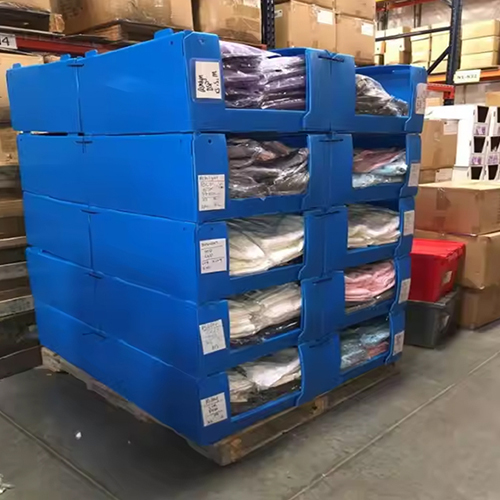
The right plastic bin manufacturers can provide more than a basic storage container. For clothing warehouses, textile centers, large logistics operations, distribution centers, and e-commerce warehouses, well-designed stackable PP bins can support better organization, vertical space utilization, product protection, picking, sorting, and repeated material handling.
When sourcing from China, buyers should compare material quality, structural strength, customization options, production consistency, quality control, and export packaging instead of focusing only on price. By matching the bin structure to the actual workload and warehouse process, companies can develop a reusable storage system that supports efficient day-to-day operations.