
- Sophia@polyflute.com
- +86 15162372874
- Mon - Sat 8:00-20:00

Plastic corrugated packaging is widely used in modern logistics, manufacturing, warehousing, agriculture, and retail because it combines lightweight construction with durability and moisture resistance. Made primarily from corrugated polypropylene (PP) sheets, this packaging material provides a practical alternative to traditional cardboard for applications that require repeated handling, easy cleaning, and reliable product protection. Businesses can choose from different sheet thicknesses, colors, sizes, and box designs to meet specific packaging and transportation requirements.
Understanding the materials, available formats, and practical advantages of plastic corrugated packaging helps businesses select suitable solutions for their products and supply chains. From reusable distribution boxes to protective dividers and custom inserts, this packaging category offers considerable flexibility for both standard and specialized applications.
Different packaging formats serve different operational needs. Selecting the appropriate type depends on product dimensions, weight, handling conditions, storage requirements, and whether the packaging will be reused.
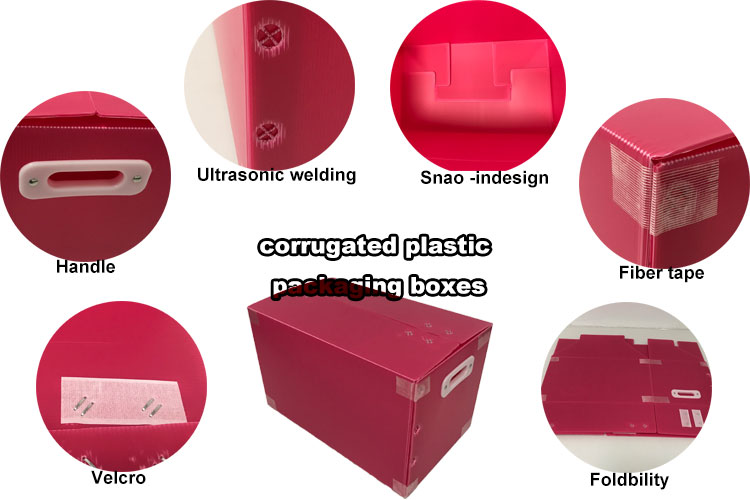
Corrugated plastic boxes are among the most common products in this category. They are manufactured by cutting and folding plastic sheets into box structures, with optional lids, handles, locking tabs, and reinforced edges.
These boxes are frequently used for automotive components, electronic parts, industrial supplies, medical products, and warehouse distribution. Their lightweight construction makes them convenient to handle, while their rigid walls help protect contents during storage and transportation.
Businesses can order boxes in custom dimensions to reduce unused space and improve packing efficiency. Dividers or foam inserts can also be added when products require separation or additional protection.
Reusable containers are designed for repeated movement between production facilities, distribution centers, suppliers, and customers. They are commonly incorporated into returnable packaging systems used in manufacturing and industrial logistics.
Compared with disposable packaging, reusable containers can reduce the need for frequent replacement when they are properly designed, maintained, and returned through an organized collection system.
Common features include reinforced corners, foldable designs, identification labels, and stackable structures. The best configuration depends on the load, transport distance, storage arrangement, and expected number of reuse cycles.
Flat corrugated plastic sheets can be used as protective layers, separators, and packaging components. They are often placed between products to prevent direct contact, reduce surface scratching, and improve organization inside shipping containers.
Custom-cut dividers are especially useful for glass products, automotive parts, electronics, and other items that should remain separated during transit. Different divider layouts can accommodate products with varying shapes and dimensions.
Sheets can also serve as internal partitions in larger boxes. By creating individual compartments, businesses can improve packing consistency and reduce movement inside the package.
Trays and bins provide convenient solutions for organizing products during assembly, inspection, storage, and distribution. Their open structures make contents easy to access, while custom compartments help maintain product positioning.
These products are commonly used in production lines, component storage areas, agricultural operations, and retail supply chains. Depending on the application, they may be designed with handles, reinforced bases, or dimensions compatible with existing storage systems.
Some products require packaging that does not fit standard box dimensions. Custom plastic corrugated packaging can incorporate specialized folds, cutouts, partitions, sleeves, and protective covers to accommodate unusual shapes or sensitive components.
For example, manufacturers can develop packaging for long mechanical parts, irregular automotive components, lightweight assemblies, or products that must be separated into individual compartments.
Custom designs can also support product identification through printed graphics, labels, barcodes, and color coding.
The popularity of plastic corrugated packaging comes from its combination of practical performance characteristics and design flexibility.
The hollow fluted structure provides stiffness while keeping the overall material relatively light. This helps businesses handle packaging efficiently and may reduce packaging weight compared with some heavier alternatives.
Actual performance depends on sheet thickness, flute geometry, material grade, box dimensions, and the distribution of the load. Heavy products may require reinforced designs or additional structural support.
Polypropylene is generally resistant to water and many common environmental moisture conditions. Consequently, corrugated PP packaging can be useful in warehouses, agricultural facilities, and distribution environments where ordinary paperboard may soften after exposure to moisture.
However, moisture resistance does not automatically make every package waterproof. Open seams, cut edges, closures, and accessories may allow water to enter, so the complete packaging design must match the intended conditions.
Many plastic corrugated products can withstand repeated handling when used within their design limits. This makes them suitable for closed-loop logistics, internal material movement, and reusable packaging programs.
Their service life depends on load weight, impact frequency, exposure to sunlight, temperature, cleaning procedures, and storage practices. Damaged containers should be inspected and replaced when their structural integrity is compromised.
The relatively smooth surface of polypropylene packaging is generally easier to wipe clean than absorbent paper-based materials. This characteristic can be valuable in facilities where packaging encounters dust, splashes, or routine handling contamination.
Cleaning agents, temperature limits, and hygiene requirements should be checked before use, especially in regulated environments or applications involving sensitive products.
Plastic corrugated packaging can be manufactured in a wide range of colors, thicknesses, dimensions, and configurations. Manufacturers can adapt box designs, partition layouts, printing, and reinforcement to specific operational needs.
This flexibility allows businesses to standardize packaging across product lines while accommodating different component sizes and handling procedures.
Plastic corrugated packaging supports a broad range of commercial and industrial activities.
Automotive manufacturing: Factories use reusable boxes, trays, and dividers to move fasteners, molded components, electrical connectors, and other parts between suppliers and assembly stations. Dedicated compartments can reduce mixing and help protect finished surfaces.
Electronics and electrical equipment: Corrugated PP containers can organize cables, housings, accessories, and components. Antistatic or static-dissipative versions may be appropriate for certain electronic products, but the required electrical properties must be verified rather than assumed.
Agriculture and food distribution: Plastic corrugated boxes and sheets can support the movement of produce, seedlings, and agricultural supplies. For direct food contact, businesses should confirm that the material and complete packaging system meet applicable food-contact requirements.
Warehousing and e-commerce: Custom boxes, picking bins, and dividers help organize inventory and improve product handling. Foldable containers can also reduce return-trip storage volume when their design permits efficient collapse.
Healthcare and laboratory supplies: Packaging can be customized to organize non-sterile supplies, equipment accessories, and laboratory components. Applications involving sterile products or regulated medical devices require additional validation and compliance checks.
Retail and promotional activities: Printed corrugated plastic packaging can support product displays, temporary storage, and branded distribution materials. Its surface can accommodate identification information and selected graphic designs.
Plastic corrugated packaging offers a versatile solution for businesses seeking lightweight, customizable, and potentially reusable packaging for industrial, commercial, and distribution operations. Its main formats include boxes, returnable containers, sheets, dividers, trays, and custom protective structures.
To achieve the best results, buyers should assess product dimensions, load requirements, environmental exposure, reuse expectations, and customization needs before selecting a packaging design. Comparing material specifications, testing samples, and evaluating lifecycle costs can help businesses identify packaging that supports efficient handling, reliable product protection, and long-term operational value.