
- Sophia@polyflute.com
- +86 15162372874
- Mon - Sat 8:00-20:00

For businesses that need durable, lightweight, and reusable packaging, pp box packaging is a practical solution for many industries. Made from polypropylene (PP), these boxes can provide a useful combination of impact resistance, moisture resistance, low weight, and easy handling. Compared with conventional paper cartons and some rigid packaging materials, PP boxes can be reused for repeated transportation, storage, distribution, and product protection.
For importers, distributors, manufacturers, and wholesalers, sourcing PP boxes directly from a China manufacturer can also provide more options for customization. Dimensions, thickness, colors, printing, partitions, lids, handles, and structural designs can be adjusted according to different products and logistics requirements.
PP box packaging refers to packaging boxes manufactured primarily from polypropylene sheets or PP hollow boards. Depending on the structure and application, these boxes can be produced as folding boxes, stackable boxes, storage containers, turnover boxes, shipping boxes, or customized packaging solutions.
PP hollow board is particularly suitable for packaging because its hollow structure helps reduce weight while maintaining useful rigidity. The material can be processed through cutting, creasing, folding, welding, printing, and other manufacturing methods.
Common characteristics include:
These characteristics make PP packaging suitable for both industrial and commercial applications.
One important reason companies select pp box packaging is its potential for repeated use. Paper cartons are commonly designed for limited cycles of transportation, while properly designed PP boxes can be used multiple times when handled under suitable conditions.
This can be particularly useful for closed-loop logistics. A manufacturer can send components to an assembly plant, receive empty boxes back, and reuse them for another shipment. The same concept can also be applied to warehouses, distributors, automotive supply chains, and other industries with recurring transportation routes.
The lightweight nature of PP also helps simplify handling. Workers can move empty and loaded boxes more easily compared with heavier rigid containers.
PP boxes can also help protect products from moisture during transportation and storage. For products that may be exposed to humidity, condensation, or occasional water contact, PP packaging can offer advantages over ordinary paper-based packaging.
The versatility of PP allows manufacturers to produce packaging for different product categories.
Automotive components often require organized packaging during transportation between suppliers, factories, warehouses, and distributors. PP boxes can be designed with internal dividers or partitions to separate individual components.
This can help reduce contact between parts and make loading and unloading more efficient. Customized dimensions can also help manufacturers use available storage space more effectively.
Small electronic and electrical components may need protection from impact, dust, and moisture during transportation. PP boxes can be manufactured with compartments to keep products separated.
Printing can also be added to identify part numbers, handling instructions, product information, or company details.
PP is resistant to moisture and relatively easy to clean, making suitable PP packaging useful for selected agricultural and food-related applications where the specific material grade and regulatory requirements are appropriate.
Ventilation holes, reinforced edges, or customized openings can be incorporated into certain box designs according to the application.
For industrial manufacturers, PP boxes can be used for bearings, hardware, plastic components, machine parts, tools, and other products. A manufacturer can customize the box according to product dimensions rather than relying entirely on standard packaging sizes.
This approach can reduce unnecessary empty space and improve product organization.
A major advantage of working directly with a China manufacturer is the ability to develop customized packaging according to purchasing requirements.
A buyer may specify:
For example, a buyer transporting several small components may require a PP box with multiple internal compartments. Another customer may need a large folding box that can be stored flat when empty. These two applications require different structural designs even though both use polypropylene.
A professional manufacturer can review product dimensions and transportation conditions before recommending a suitable structure.
Material thickness is an important consideration when ordering pp box packaging. Thicker PP hollow board generally provides greater rigidity, but it can also increase material consumption and overall weight.
The appropriate thickness depends on several factors, including product weight, box dimensions, stacking requirements, transportation distance, and expected reuse cycles.
For lightweight products, a thinner board may be sufficient. Heavier components or boxes designed for repeated stacking may require a stronger construction.
Therefore, buyers should not select thickness based solely on price. A suitable specification should balance structural performance, product protection, weight, and total packaging cost.
PP boxes can also function as packaging and identification tools. Logos, product names, model numbers, warning information, and handling instructions can be printed directly onto suitable PP surfaces.
For companies operating a closed logistics system, printed boxes can make it easier to identify packaging ownership and product categories.
Different colors can also be used for warehouse organization. For example, separate colors may represent different production lines, product categories, or customer orders.
For large-volume B2B orders, customized printing and color selection can be discussed with the manufacturer during the quotation and sampling stage.
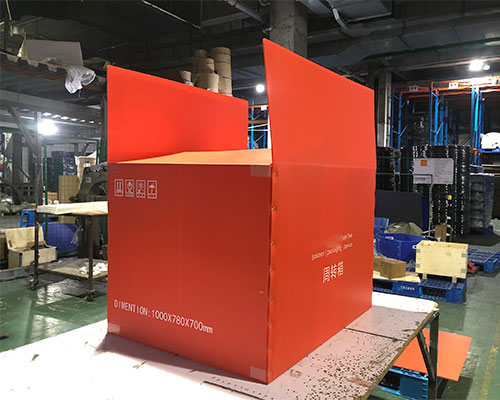
Before requesting a quotation, buyers should prepare basic product information. This allows the manufacturer to provide a more accurate recommendation and price.
The key information normally includes the required box dimensions, product dimensions, approximate product weight, expected order quantity, desired material thickness, printing requirements, and intended application.
Buyers should also explain whether the boxes will be used for one-way shipping, warehouse storage, or repeated transportation. If stacking is required, the expected stacking conditions should also be provided.
For custom orders, it is usually useful to request a sample before mass production. A sample allows buyers to check dimensions, folding performance, printing quality, structural strength, and compatibility with the products.
After the design is confirmed, the manufacturer can proceed with bulk production according to the approved specifications.
Purchasing directly from a manufacturer can simplify communication between the buyer and production team. Instead of selecting only from existing standard products, B2B customers can discuss custom specifications based on their actual packaging requirements.
Direct manufacturing also allows buyers to communicate details such as material thickness, printing, box construction, production quantity, and packing methods more efficiently.
For distributors and importers, manufacturers can also support larger-volume orders and customized packaging programs. The exact minimum order quantity, lead time, and customization options should be confirmed according to the specific project.
PP box packaging provides a flexible option for businesses looking for lightweight, reusable, moisture-resistant, and customizable packaging. Its suitability for automotive parts, industrial components, electronics, agriculture, and other applications makes it useful for a wide range of B2B supply chains.
For companies sourcing customized packaging, working with a China manufacturer can provide greater flexibility in dimensions, thickness, colors, printing, partitions, and structural designs. By providing accurate product information and confirming samples before mass production, buyers can develop PP boxes that better match their transportation, storage, and product protection requirements.
When evaluating suppliers, businesses should consider material quality, manufacturing capabilities, customization experience, production capacity, quality control, packaging methods, and communication efficiency rather than focusing only on the initial unit price. A suitable pp box packaging solution should ultimately support both product protection and efficient long-term logistics.