
- Sophia@polyflute.com
- +86 15162372874
- Mon - Sat 8:00-20:00

Efficient storage is essential for keeping warehouse operations organized, productive, and cost-effective. As warehouses handle an increasing variety of products, components, tools, and materials, choosing the right storage bins warehouse solution can make a significant difference. Properly designed storage bins help maximize available space, simplify inventory management, reduce picking time, and protect products from damage.
However, warehouses have different layouts, storage requirements, product sizes, and handling processes. A bin that works well for small hardware may not be suitable for large components or heavy industrial parts. Understanding the different types of warehouse storage bins and knowing how to select them is therefore important for warehouse managers, distributors, manufacturers, and logistics companies.
This guide explains the main types of storage bins warehouse systems, their applications, advantages, and the key factors to consider when selecting the right solution.
Warehouse storage is not simply about putting products on shelves. A well-organized storage system should make inventory easy to identify, access, move, and replenish. Storage bins provide a practical way to divide inventory into manageable units while keeping products protected and organized.
One major advantage of using storage bins is improved space utilization. Instead of placing loose products directly on shelves, bins create defined storage compartments. This allows vertical space to be used more efficiently and helps prevent products from spreading across multiple locations.
Storage bins can also improve picking efficiency. When products have clearly assigned locations, warehouse workers can identify and retrieve items more quickly. Labels, barcodes, or other identification systems can be added to the front of bins to further simplify inventory control.
For businesses handling many small or medium-sized products, an appropriate storage bins warehouse system can also reduce inventory errors. Each product or product category can have a dedicated location, making stock counting and replenishment easier.
There are several types of storage bins available for warehouse applications. Each type has different characteristics and is designed for particular storage conditions.
Plastic storage bins are among the most commonly used solutions in modern warehouses. They are typically manufactured from durable plastic materials and are available in many different sizes, shapes, and configurations.
Plastic bins are suitable for storing small parts, fasteners, electrical components, tools, packaging materials, and other products. Their smooth surfaces make them relatively easy to clean, while their resistance to moisture and corrosion makes them useful in many industrial environments.
Many plastic bins can be stacked when they are not being used on shelving. Some models are also designed to work with warehouse racks, cabinets, and automated storage systems.
For warehouses looking for a flexible and reusable storage bins warehouse solution, plastic bins are often a practical choice.
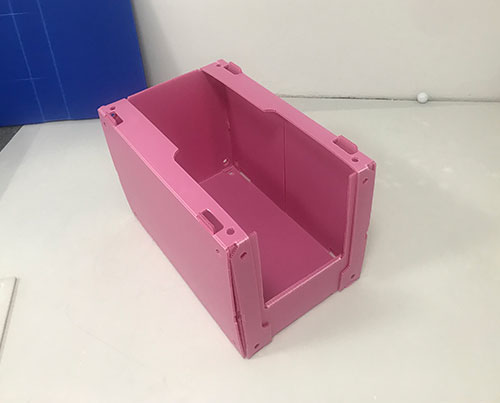
Corrugated plastic bins are another useful option, particularly for lightweight industrial products, components, packaging, and distribution applications. These bins are made from corrugated polypropylene sheets, which provide a combination of low weight and structural strength.
One advantage of corrugated plastic is its flexibility. Bins can be produced in different dimensions and configurations to match specific storage requirements. They can also be printed or labeled for product identification.
Because corrugated plastic is lightweight, these bins can be easier to handle than heavier storage containers. They are particularly useful when bins need to be frequently moved between warehouse areas, production lines, or distribution centers.
Stackable bins are designed to maximize vertical storage space. Their structure allows one bin to be placed securely on top of another, reducing the amount of floor space required.
Stackable bins are suitable for warehouses where floor space is limited. They are commonly used for small parts, accessories, tools, components, and packaged products.
When selecting stackable bins, stability is important. The design should allow bins to remain secure when stacked and loaded. The maximum stacking height should also be considered according to the bin’s material, dimensions, and load capacity.
Shelf bins are designed specifically for use with warehouse shelving systems. They generally have an open front, allowing workers to access stored items without removing the bin from the shelf.
These bins are particularly useful for order picking. Products can be arranged by SKU, size, category, or frequency of use. Frequently picked items can be positioned at convenient heights to reduce unnecessary movement.
Shelf bins are commonly found in warehouses, workshops, spare-parts centers, maintenance departments, and manufacturing facilities.

Tilt bins feature a front-opening design that allows the container to tilt forward while remaining attached to a storage rack or cabinet. This gives workers convenient access to the contents.
They are useful for environments where products need to be picked frequently throughout the day. Small components, fasteners, electronic parts, and maintenance supplies can be organized into individual compartments.
The transparent or semi-transparent construction available in some designs can also make it easier to identify contents without opening the bin.
Bulk bins are larger containers designed for storing relatively large quantities of materials or products. Compared with small parts bins, they provide greater capacity and are suitable for larger components, packaging materials, raw materials, and industrial supplies.
Bulk storage bins may be made from heavy-duty plastic or other durable materials depending on the application. Some designs can be stacked, while others are intended for use on pallets or warehouse floors.
When selecting bulk bins, load capacity, dimensions, handling requirements, and available storage space should be carefully evaluated.
Hanging bins are designed to attach to panels, rails, racks, or specially designed walls. They are useful when floor and shelf space is limited.
These bins are often used in workshops, maintenance areas, assembly lines, and warehouses that handle many small components. Hanging systems make it possible to organize products vertically while keeping frequently accessed materials within easy reach.
Different industries may require different storage solutions.
Manufacturing facilities often use bins for components, raw materials, tools, and work-in-process items. Automotive warehouses may use bins for spare parts, accessories, and maintenance components. Electronics facilities may require smaller compartments for sensitive or precision components.
E-commerce fulfillment centers often prioritize picking speed and SKU organization. Distribution centers may require stackable or bulk containers that can support frequent movement.
Therefore, there is no single storage bin that is ideal for every warehouse. The best solution depends on product characteristics, handling frequency, storage density, and operational requirements.
Choosing the right storage bins warehouse solution can have a direct impact on warehouse organization, storage capacity, picking efficiency, and inventory management. Plastic storage bins, corrugated plastic bins, stackable bins, shelf bins, tilt bins, bulk bins, and hanging bins each provide different advantages for specific applications.
The best choice depends on several factors, including product dimensions, load capacity, warehouse layout, accessibility, material requirements, labeling, durability, and future storage needs.
Rather than selecting bins simply because they are inexpensive or visually convenient, warehouse operators should evaluate the complete storage process. A well-planned bin system can help businesses make better use of available space, reduce handling time, protect inventory, and create a more organized working environment.
As warehouse operations continue to become more efficient and data-driven, flexible and durable storage solutions will remain an important part of modern inventory management. By matching the right bin type to the right application, businesses can build a storage system that supports both current operations and future growth.