
- Sophia@polyflute.com
- +86 15162372874
- Mon - Sat 8:00-20:00

Modern warehouses require efficient storage and organization systems to improve productivity, reduce handling time, and maintain accurate inventory control. Among various warehouse storage solutions, corrugated bins for warehouse applications have become increasingly popular because they are lightweight, recyclable, cost-effective, and easy to customize.
Corrugated bins are mainly made from corrugated cardboard or corrugated plastic materials. They are designed to store, organize, and transport different types of products, from small components and electronic parts to retail goods and industrial supplies. Compared with traditional plastic containers or metal storage boxes, corrugated bins offer advantages such as lower cost, easy assembly, space-saving design, and excellent printing capability for product identification.
Depending on warehouse requirements, corrugated bins can be divided into several categories based on structure, application, loading capacity, and storage method. Understanding these categories helps businesses select the right storage solution for improving warehouse efficiency.
Corrugated picking bins are one of the most common types used in warehouses, especially in order fulfillment centers, distribution facilities, and manufacturing workshops.
These bins are designed for quick access to frequently used products. Their open-front design allows workers to easily identify and pick items without removing the entire container from the storage area.
Corrugated picking bins are widely used for storing:
In warehouses with high-frequency picking operations, these bins help reduce searching time and improve employee efficiency.
Stackable corrugated bins are designed with reinforced structures that allow multiple bins to be placed vertically. This category is ideal for warehouses where maximizing storage space is a priority.
By using vertical space effectively, stackable bins help increase warehouse storage capacity without requiring additional floor space.
Stackable corrugated bins usually feature reinforced side walls and strong bottom panels to support heavier loads. Some designs include interlocking structures that prevent bins from sliding when stacked.
These bins are commonly used in:
Corrugated shelf bins are specifically designed to fit warehouse shelving systems. They are commonly used together with pallet racks, industrial shelves, and modular storage systems.
These bins provide a neat and organized appearance while making inventory management easier.
Shelf bins are especially useful for warehouses that store thousands of small products. By assigning each bin to a specific product category, workers can quickly locate items and reduce picking errors.
For example, a warehouse storing machine parts may use different shelf bins for bearings, bolts, connectors, and tools.
Corrugated divider bins include internal partitions that separate different products inside one container.
This design is useful when warehouses need to store multiple small items while preventing mixing or damage.
The internal dividers can be customized according to product dimensions. Businesses can choose different numbers of compartments, divider heights, and layouts.
Benefits include:
Divider bins are especially valuable for industries requiring organized storage of small and fragile products.
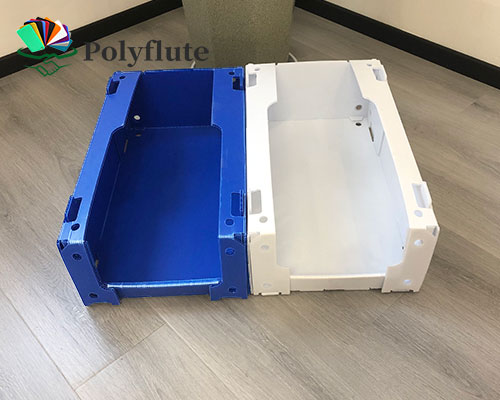
Although traditional corrugated bins are often made from cardboard, corrugated plastic bins have become an important alternative for warehouses requiring higher durability.
Corrugated plastic, also known as corrugated polypropylene sheet, provides better resistance against moisture, chemicals, and repeated handling.
These bins are commonly used in:
Compared with paper-based corrugated bins, corrugated plastic bins usually have a longer service life and can withstand more demanding warehouse conditions.
Collapsible corrugated bins are designed to save transportation and storage space when they are not in use.
They can be folded flat when empty and quickly assembled when needed.
These bins are widely used in supply chains where containers need to move between suppliers, warehouses, and production facilities.
For example, automotive suppliers often use collapsible bins to deliver components between factories. After unloading, empty bins can be folded and returned efficiently.
Corrugated storage totes are larger containers designed for storing and transporting medium-sized products.
Unlike small picking bins, storage totes provide higher capacity and stronger construction.
Corrugated storage totes are commonly used for:
They are often used in warehouses that require both storage and internal transportation functions.
Every warehouse has different storage requirements. Custom corrugated bins are designed according to specific product sizes, warehouse layouts, and operational processes.
Manufacturers can customize:
Custom corrugated bins are especially useful for companies handling unique products that cannot fit standard storage containers.
Industries that frequently use customized solutions include:
A properly designed custom bin can improve storage efficiency while reducing wasted space.
Corrugated bulk bins are large-capacity containers designed for storing and transporting heavy or large quantities of products.
They are usually manufactured with multiple layers of corrugated material to provide higher strength.
Bulk bins help reduce the number of individual containers required and simplify warehouse handling.
They are commonly used in warehouses that manage high-volume inventory.
Warehouse organization depends heavily on clear identification. Printed corrugated bins provide excellent opportunities for branding, product classification, and inventory management.
Businesses can add:
Clear labeling helps workers quickly identify products and improves inventory accuracy.
These bins are particularly useful in automated warehouses and distribution centers where accurate product tracking is essential.
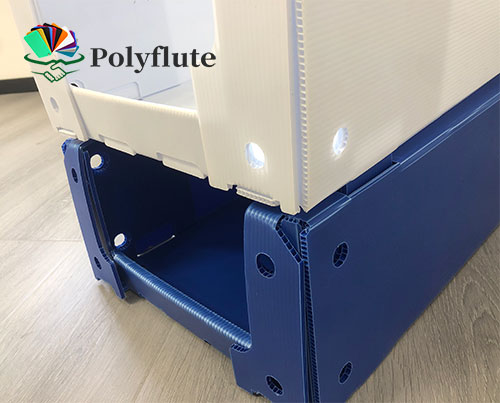
Selecting the right corrugated bins depends on several factors:
Small components require compact picking bins, while larger products may need bulk bins or storage totes.
For dry indoor warehouses, cardboard corrugated bins may be sufficient. For humid or demanding environments, corrugated plastic bins are usually a better choice.
Products picked frequently should use open-front picking bins. Products stored for longer periods may require stackable or shelf bins.
Warehouses with limited floor space should consider stackable or collapsible designs.
There are many categories of corrugated bins for warehouse applications, each designed for different storage and handling requirements. Picking bins provide quick access to frequently used items, stackable bins maximize storage space, shelf bins improve organization, and divider bins protect small components. For demanding environments, corrugated plastic bins offer excellent durability, while custom solutions provide the flexibility needed for specialized products.
Choosing the right type of corrugated bin can significantly improve warehouse organization, reduce handling time, and increase overall operational efficiency. As warehouses continue to focus on automation, space optimization, and efficient inventory management, corrugated bins will remain an important storage solution for modern logistics and manufacturing industries.
Top 5 Corrugated Plastic Sheets Manufacturer In China | 17 Years Of Export ExperienceDesign & Developed by VW Themes
WhatsApp us