
- Sophia@polyflute.com
- +86 15162372874
- Mon - Sat 8:00-20:00

Efficient storage and organization are essential for modern manufacturing, warehousing, and distribution operations. As companies handle increasing numbers of small components, spare parts, and production materials, choosing the right storage container can significantly improve workflow efficiency and inventory management. A corrugated parts bin is a practical packaging and storage solution designed to organize products while providing lightweight construction, easy handling, and cost-effective performance.
Made from corrugated plastic or corrugated fiberboard materials, these bins are widely used in automotive manufacturing, electronics production, industrial assembly, logistics centers, and spare parts storage. Compared with traditional storage containers, corrugated bins offer advantages such as customization, stackability, recyclability, and flexible design options.
Understanding different types of corrugated parts bins and how to select the right one can help businesses improve warehouse organization while reducing packaging costs.
Businesses choose corrugated parts bins because they provide several operational advantages.
In manufacturing environments, thousands of small components may need to be stored and accessed daily. Loose storage can create problems such as:
A well-designed corrugated parts bin allows operators to separate items according to size, model, production stage, or application.
Corrugated materials provide a strong strength-to-weight ratio. Workers can move and rearrange bins easily without requiring heavy lifting equipment.
This is especially useful in:
Compared with metal containers or heavy-duty plastic boxes, corrugated parts bins generally require lower production costs while still providing reliable performance.
Manufacturers can also customize dimensions and designs according to specific storage requirements, reducing wasted space.
Small parts often require protection from scratches, impact, dust, and contamination. Corrugated bins help prevent components from being mixed together or damaged during transportation and storage.
Different industries have different storage requirements, so corrugated parts bins are available in various designs and structures.
Standard bins are the most commonly used type for general industrial storage.
They usually feature:
These bins are suitable for storing:
Standard designs are often used on shelves, racks, and workstations.
Corrugated plastic parts bins are manufactured from lightweight polypropylene sheets with a hollow fluted structure.
Compared with paper-based alternatives, they provide:
These characteristics make them suitable for demanding industrial environments.
Common applications include:
For companies requiring reusable packaging, corrugated plastic bins are often a preferred choice.
Stackable designs help maximize warehouse space utilization.
These bins are engineered with reinforced structures that allow multiple containers to be stacked vertically without deformation.
Advantages include:
Stackable corrugated parts bins are commonly used in distribution centers and manufacturing facilities where floor space is limited.
Divider bins include internal partitions that separate different products within one container.
They are ideal for storing:
The divider system prevents products from contacting each other, reducing scratches and improving sorting efficiency.
Dividers can usually be customized according to:
Foldable bins are designed to save storage space when they are not in use.
When empty, they can be folded flat for:
They are particularly useful in reusable packaging systems where containers frequently move between suppliers and customers.
Many industrial applications require customized packaging solutions because products vary significantly in shape, weight, and handling requirements.
Custom corrugated parts bins can be designed with:
Customized solutions are widely used in automotive, aerospace, electronics, and industrial equipment industries.
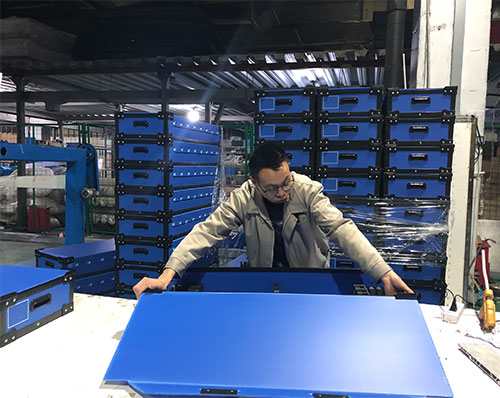
The material selection directly affects durability, cost, and application performance.
Corrugated polypropylene is one of the most popular materials for reusable industrial bins.
Key advantages include:
This material performs well in environments where moisture or frequent handling is involved.
Corrugated cardboard bins are economical and suitable for short-term applications.
Advantages include:
However, cardboard has lower moisture resistance and durability compared with corrugated plastic.
For electronics manufacturing, anti-static materials may be required to protect sensitive components.
These bins help reduce the risk of electrostatic discharge damage during storage and transportation.
Corrugated parts bins are used across many industries due to their flexibility and customization options.
Automotive manufacturers use corrugated bins for organizing:
They support just-in-time manufacturing systems by keeping components organized and accessible.
Electronic components require careful handling because many parts are small and sensitive.
Corrugated bins help store:
Anti-static options are often selected for electronic applications.
Distribution centers use corrugated bins to improve picking efficiency and inventory control.
Benefits include:
Manufacturers of machinery and equipment often use bins for organizing fasteners, tools, and replacement parts.
Selecting the correct bin requires considering several important factors.
The first step is determining the dimensions and quantity of the items being stored.
Important considerations include:
A properly sized bin improves storage efficiency and prevents unnecessary movement of products.
Choose the material according to the working environment.
For example:
Different products require different levels of structural strength.
Heavy components may need:
Lightweight parts may only require standard designs.
Environmental factors should also influence selection.
Consider:
For harsh industrial environments, corrugated plastic solutions usually provide better performance.
Additional features can improve usability, including:
These options help companies create more efficient storage systems.

A corrugated parts bin is an effective storage and handling solution for industries that require organized, durable, and flexible component management. With different designs including standard bins, stackable bins, divider bins, foldable bins, and customized solutions, businesses can select options that match their operational requirements.
When choosing the right corrugated parts bin, companies should consider product size, material performance, load capacity, environmental conditions, and customization needs. By selecting a suitable storage solution, manufacturers and warehouses can improve efficiency, reduce handling costs, and create a more organized working environment.
For modern industrial operations, corrugated parts bins provide a practical balance between durability, flexibility, and cost efficiency, making them an essential component of efficient material management systems.